
 ONLINE VAPE STORE UK.
FREE DELIVERY OVER £40
- SAME DAY DISPATCH - ORDER BY 4PM
ONLINE VAPE STORE UK.
FREE DELIVERY OVER £40
- SAME DAY DISPATCH - ORDER BY 4PM
 01772 230513
UK Guide to Vape Laws Abroad
Planning to travel with a vape? Learn the latest vape laws abroad, airport rules, country bans, and travel advice for UK vapers in 2026.

Going to a different country with a vape device requires some preparation since the laws that may be applied in the UK are not going to be the same in other places. For example, there are many vacation destinations that have tight controls concerning vape devices in terms of importing, owning, selling, and using them. Some of such destinations include Thailand, Singapore, Mexico, India, Vietnam, among others, where total bans or tough penalties may be imposed. In this article, you will learn about the basic vape travel laws that you need to know if you are from the UK and plan on going on vacation.
If you are an adult who uses vapes and travels out of the UK, this article will prove useful for you. It covers everything from airline requirements, UK airport regulations, country-specific restrictions, vape flavor bans, nicotine restrictions, and more.
Featured Products




Table of Contents
Vape Travel Rules for UK Holidaymakers
A vape that is legal in the UK may still be illegal to import, possess, buy or use abroad. UK travellers should check official foreign travel advice, customs rules and local laws before packing vape devices, pods, cartridges or e-liquids. UK airport guidance says e-cigarettes can be carried in hand luggage but not hold luggage, while UK vape product rules limit nicotine-containing e-liquids to 20mg/ml, refill containers to 10ml and tanks to 2ml. These UK rules do not override destination-country laws.
Article at a Glance
UK holidaymakers should not assume that a vape which is legal in Britain is legal abroad. Official travel, customs and tobacco-control guidance shows that countries including Thailand, Singapore, Mexico, India, Vietnam, Hong Kong, Brazil, Laos, Qatar, Oman, Kyrgyzstan, Kazakhstan, Mauritius, Nicaragua, Cambodia and Brunei have bans or severe restrictions affecting one or more of vape import, possession, sale or use.
Even where vaping is legal, travellers may face nicotine limits, public-use restrictions, flavour bans, customs rules or higher prices. The safest advice is to check official guidance before departure, keep any permitted vape products in hand luggage, carry only a lawful personal-use amount and avoid packing vapes entirely where rules are strict or unclear.
Countries Where UK Travellers Should Not Pack Vapes
Thailand
UK travellers should treat Thailand as one of the highest-risk destinations for vaping products. Official UK travel advice says it is illegal to possess or use any vape, e-cigarette, pod, e-liquid or heat-not-burn device in Thailand. Offences can lead to confiscation, detention, court proceedings and heavy fines, typically between 5,000 and 30,000 Thai baht. GOV.UK also says there are no tourist or personal-use exceptions.
Singapore
Travellers should not pack vapes or e-cigarettes for Singapore. UK government travel advice says vaporisers and e-cigarettes are illegal to bring into Singapore, and Singapore's Health Sciences Authority says possession, use, purchase, import and supply of e-vaporisers can trigger penalties. The safest advice is not to carry vapes into Singapore at all, even for personal use.
Mexico
Mexico should also be treated as a high-risk destination. UK Government travel advice says it is illegal to bring e-cigarettes, vaping devices and solutions into Mexico, or to buy and sell them there. Customs officials can confiscate these items, and travellers could be fined or detained.
GOV.UK also warns that smoking or vaping in a public place can lead to a fine of up to 3,000 Mexican pesos.
India
Travellers should not take vapes to India. GOV.UK says vapes and related products are banned, and travellers cannot buy vapes in India or bring them into the country. This means UK holidaymakers should avoid packing vape devices, pods, cartridges or e-liquids when travelling to India.
Vietnam
Vapes and related products are banned in Vietnam. GOV.UK travel advice says travellers cannot buy vapes in Vietnam or bring them into the country. People caught using e-cigarettes can face fines of VND3 million to VND5 million, which is roughly £85 to £142. For UK travellers, the safest advice is to leave vape devices, pods and liquids at home before travelling to Vietnam.
Hong Kong
Hong Kong has strict rules on alternative smoking products. UK government travel advice for Hong Kong says it is prohibited to bring e-cigarettes, heated tobacco products, herbal cigarettes or related devices into Hong Kong, including in personal luggage.
Since 30 April 2026, possessing any e-cigarette or alternative smoking product in a public place is also illegal. Possession of these items or their components can result in imprisonment and substantial fines, although travellers transiting airside without passing immigration are treated differently.
People caught with small quantities can face a fixed penalty of HK$3,000, while larger quantities can lead to prosecution, a fine of up to HK$50,000 and imprisonment for up to six months.
Brazil
Travellers should avoid packing vapes for Brazil. GOV.UK travel advice for Brazil says all electronic cigarettes and vaping devices are illegal in Brazil, including refills, parts and accessories. Customs officials can confiscate vape products found in checked luggage or carry-on luggage during inspections.
Laos
Laos should be treated as a high-risk country for vapes. GOV.UK travel advice says the use of e-cigarettes, vapes, heated tobacco and shisha is illegal. It also says travellers could be fined or imprisoned for possessing, using, importing, selling, purchasing or exporting these products.
Qatar
Travellers should not vape in Qatar. GOV.UK says it is illegal to vape or use an e-cigarette in Qatar, and police can arrest offenders. Courts may impose a fine, prison sentence or deportation.
Oman
Oman should be treated as a high-caution destination. Tobacco Control Laws says Oman bans the import and trade of e-cigarettes, and travellers should avoid packing vape products unless they have checked current official customs guidance.
Kyrgyzstan
UK travel advice says it is illegal to bring e-cigarettes and vaping devices into Kyrgyzstan, or to buy and sell them there. Customs officials can confiscate these items, and travellers could be fined or detained.
Kazakhstan
Kazakhstan is a high-caution destination because GOV.UK says smoking and vaping are illegal in many public places, and it is illegal to sell, distribute, import or produce smokeless cigarettes, e-cigarettes or e-liquid for e-cigarettes. Official UK government advice says offences can lead to a fine or a prison sentence of up to two years.
Mauritius
Mauritius is included as a red-list destination for vapes. Tobacco Control Laws, a legal database run by the Campaign for Tobacco-Free Kids, says Mauritius bans the manufacture, import, distribution, sale or offer for sale of e-cigarettes, including e-liquids, devices and accessories.
Nicaragua
Travellers should not pack vapes for Nicaragua. GOV.UK says there is a ban on electronic smoking devices such as e-cigarettes, and that travellers cannot import, export, sell, store or use these devices, with or without nicotine. Customs officials can confiscate them at the border.
Cambodia
Cambodia should be treated as a high-risk destination for vapes and shisha. The WHO FCTC implementation database says Cambodia's national measures prohibit the consumption, sale and import of shisha and e-cigarettes. A Cambodia circular hosted by Tobacco Control Laws also refers to measures to prevent and stop the use, sale and importation of shisha and electronic cigarettes.
Brunei
Brunei should be treated with caution. Tobacco Control Laws says Brunei prohibits the import, sale and offer for sale of articles designed to resemble tobacco products, which is interpreted as covering e-cigarettes. It also says e-cigarette use is banned anywhere smoking is banned, including many public places, workplaces and public transport settings.
Mohmed Patel, Director at Ninja Vapes, said:
"Legal in the UK does not always mean legal abroad. Some countries restrict the import, possession or use of vape devices, pods, cartridges and e-liquids, even when they are carried for personal use. We are urging adult UK travellers to check the rules before they fly and, where restrictions are strict or unclear, avoid packing vape products altogether.
Adult vapers who are concerned about managing nicotine while abroad should look at legal alternatives such as approved nicotine gum or patches, or nicotine pouches only where they are permitted. The key message is simple: check before you travel."
Countries where travellers should use extra caution before packing vapes
Australia
Australia does not treat vaping like a normal retail product, so UK travellers should check the rules carefully before flying. The Australian Therapeutic Goods Administration says people entering Australia by ship or aircraft may bring only a small quantity under a traveller's exemption, and the products must be for treatment of the traveller or someone they are caring for. The maximum quantity is 2 vapes, 20 vape accessories such as cartridges, capsules or pods, and 200ml of vape substance in liquid form.
Turkey
Turkey should be treated as an extra-caution destination because vape sales and imports are heavily restricted. Tobacco Control Laws says the import of e-cigarettes is banned, although Circular No. 2020/7 provides a limited personal-use exception, including one device per person and cartridges or solutions up to 30ml, or 10 disposable electronic cigarettes in total.
Finland
Finland is not a normal "stock up and travel" destination for vape users because nicotine liquid imports are tightly limited. Finnish Customs says travellers may bring in only 10ml of nicotine liquid at most, and the nicotine liquid may be inside refill containers or disposable e-cigarettes. Finnish Customs also says the liquid must be for the traveller's own personal use, not for family members or gifts.
Norway
Norwegian Customs says that since 1 January 2026 it is prohibited to import products including vapes/e-cigarettes with nicotine, e-liquid with nicotine, and e-cigarettes/e-juice without nicotine with characterising flavours. UK travellers should check Norwegian Customs before packing any vape product.
Panama
Panama is relevant for public-use restrictions. UK government travel advice for Panama says the use of e-cigarettes is banned in public places, and people caught smoking where it is not allowed can be fined 25 to 100 US dollars. Travellers should not assume they can vape in hotels, transport hubs, restaurants or other public areas.
Countries with flavour restrictions
Netherlands
Travellers who use fruit, sweet, dessert or drink-style vape flavours should know that the Netherlands has a flavour ban on vape sales. The Dutch Food and Consumer Product Safety Authority says the sale of vapes and e-liquids with flavours such as cola, peach, cotton candy and mango is prohibited, and only tobacco flavour is allowed. The ban also covers accessories such as flavourings, beads and separate flavoured mouthpieces used to add flavour to e-cigarettes.
Denmark
Denmark restricts vape flavours to tobacco and menthol. Tobacco Control Laws says Danish law prohibits the sale of e-cigarettes or refill containers with a distinctive flavour other than menthol or tobacco, and also prohibits equipment intended to change the aroma or taste of e-cigarettes. This means fruit, sweet, candy, dessert and drink-style flavours should not be expected to be available legally.
Finland
Finland also has flavour restrictions. Tobacco Control Laws says Finnish law prohibits all e-liquid with characterising flavours, meaning the only permitted flavour is tobacco. This should be mentioned alongside the Finnish Customs 10ml nicotine liquid traveller limit.
Lithuania
Lithuania should be included for flavour restrictions. A European Commission TRIS notification says Lithuania proposed to prohibit the placing on the market of electronic cigarettes and refill containers with an added flavour other than tobacco. Another TRIS document notes that since 1 July 2022, e-liquid flavours other than tobacco have been prohibited in Lithuania.
Norway
Norway should be included both as an import-caution country and a flavour-caution country. Norwegian Customs says from 1 January 2026 it is prohibited to import e-cigarettes and e-juice without nicotine with characterising flavours, as well as nicotine vapes and nicotine e-liquid. This is especially important for travellers carrying flavoured nicotine-free products.
Popular European holiday countries where replacements may be available, but not guaranteed
Spain
Spain is a major UK holiday destination where regulated vape products may be available, but travellers should not assume they will find the same UK brand, puff count, flavour or nicotine strength. Spain is within the EU regulatory framework for e-cigarettes, where product standards apply to nicotine concentration, cartridge/tank volume and refill containers.
France
France should be treated as a regulated-market destination rather than a red-list country. Travellers may be able to buy legal replacement vape products, but the range may differ from the UK, and local public-use rules should be checked.
Italy
Italy is another popular destination where regulated vape products may be available, but UK travellers should not rely on finding the same UK-style products, flavours or device types. Buy only from legitimate retailers and check local rules before use.
Greece
Greece can be described as a regulated-market destination where travellers may find legal vape replacements, but not necessarily the same UK brand, flavour or nicotine strength. Travellers should avoid street sellers and buy only from legitimate retailers.
Portugal
Portugal is relevant as a popular summer destination where replacement products may be available through regulated sellers, but travellers should not assume UK-style disposable devices, flavours or puff counts will be available.
Germany
Germany can be included as a regulated market where vapes may be available, but local rules and product ranges can differ from the UK. Travellers should buy only from legitimate retailers and check where vaping is allowed locally.
Poland
Poland is another EU destination where regulated vape products may be available, but travellers should not rely on finding the same UK flavours, puff counts or brands. Source:
Ireland
Ireland should be treated as a regulated market where products may be available, but prices may be higher because Ireland introduced an E-Liquid Products Tax from 1 November 2025. Irish Revenue says the tax applies to all e-liquid products used in e-liquid inhalation products, including nicotine and non-nicotine e-liquids.
Quick Legal Note
This guide serves as a travel awareness guide and should not be used as a legal guide. Airport procedures and regulations are subject to change. Always check with your airline, your airport and the customs rules in the country you are travelling to and the latest UK FCDO travel advice prior to travelling.
UK Airport Rules for Travelling with Vapes
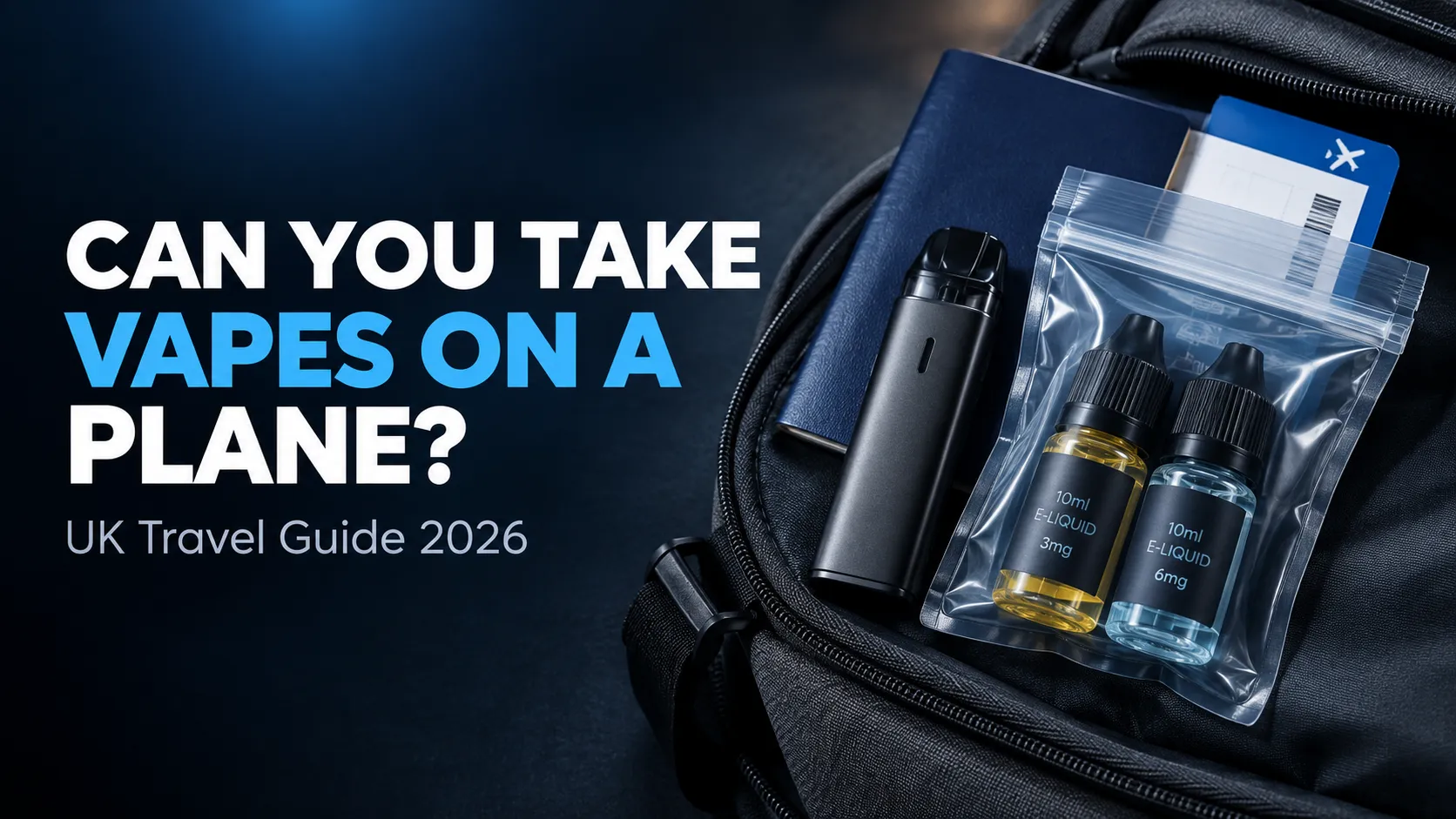
UK airport policies are predominantly around safety, if the airport is accepting vapes. If you have a vape, it has a lithium battery so it's typically requested by air carriers to be used with cabin carry rather than checked luggage. Always ensure the device is turned off, prevent the device falling on its back and do not use it on the aircraft.
Other liquids will be treated like e-liquids at security. Liquid containers are still limited in size, at many airports in the UK they must be 100ml or smaller and are required to fit in the security liquids bag. Not all airports or trips will allow larger containers, for some you may need to get newer scanners.
| Item | Human Advice Before Flying from the UK |
|---|---|
| Vape Device, Pod Kit or Mod | Keep it in cabin baggage or on you. Switch it off and stop it from firing in your bag. |
| Disposable Vape | Only pack one if it is legal where you are going. Do not put it in checked luggage. |
| E-Liquid Bottles | Treat them as liquids. Use small bottles, seal them well and keep them ready for security checks. |
| Spare Batteries | Carry them in cabin baggage only. Use battery cases so the terminals cannot touch keys, coins or metal objects. |
| During the Flight | Do not vape, charge the device, or try to use it in the toilet. Airlines take this seriously. |
Travel Checklist for Adult Vapers
- Check your destination country’s customs rules before you book or pack.
- Check UK FCDO travel advice and your airline’s battery policy.
- Confirm whether you can import, possess, use and buy vape products at your destination.
- Check public-use rules for airports, hotels, restaurants, beaches, public transport, stadiums and events.
- Keep vape devices in cabin baggage only, and only where the destination allows them.
- Keep e-liquids within the liquid limit for both departure and return airports.
- Protect batteries from short-circuiting and accidental activation.
- Never use or charge a vape on board unless airline rules allow it.
- Do not pack vapes for Thailand, Singapore, Mexico or India unless rules clearly change.
- Carry legal alternatives such as nicotine gum or patches where permitted.
- Keep receipts and packaging, but remember they do not override local laws.
- When rules are unclear, leave the vape at home.
FAQs: Vape Laws Abroad for UK Travellers
Can I take a vape on a plane from the UK?
Yes, usually if allowed by airline and destination rules. It must be carried in cabin baggage or on your person, not in checked luggage. It cannot be used onboard.
Can I put my vape in checked luggage?
No. Vapes contain lithium batteries and must be carried in cabin baggage only due to safety risks.
Can I take e-liquid in my hand luggage?
Yes, if vaping products are legal at your destination. It must follow standard airport liquid restrictions.
Can I vape inside an airport?
Only where designated smoking or vaping areas exist. Most airports restrict vaping to specific zones.
Are disposable vapes legal to travel with?
It depends on the country. Some ban possession, others ban sales or imports. Always check before travelling.
Which countries should UK vapers be most careful with?
Thailand, Singapore, Mexico and India due to strict import bans, confiscation risks and penalties.
Can I bring a vape to Mexico for the World Cup 2026?
No. Vape devices, pods, cartridges, e-liquids and disposables are not permitted in Mexico and are also banned in stadiums.
Are vape flavors banned in Europe?
Some countries restrict flavors. For example, the Netherlands allows only tobacco-flavored or unflavored products.
Will customs accept that my vape is only for personal use?
Not always. Personal use does not guarantee exemption from confiscation or fines.
What should I do if I cannot find a clear answer?
Do not pack vaping products until you verify rules through official customs, embassy, airline, or UK FCDO sources.
Why Trust Ninja Vapes UK?
Lowest Price Guaranteed
Your savings, our promise.
5% Cashback on Orders
Earn rewards with every purchase.
Trusted by customers.
Free delivery over £40
Shop more, save more






Rabbya Tahir serves as Content Manager at Ninja Vapes, where she directs the production of the company's guides and reviews. Her expertise lies in distilling technical product knowledge into clear, actionable content for a broad customer base. Committed to accuracy and accessibility in equal measure, she ensures that every article — from beginner's guides to advanced maintenance tips — reflects the practical realities of everyday vaping.
0 Replies