
 ONLINE VAPE STORE UK.
FREE DELIVERY OVER £40
- SAME DAY DISPATCH - ORDER BY 4PM
ONLINE VAPE STORE UK.
FREE DELIVERY OVER £40
- SAME DAY DISPATCH - ORDER BY 4PM
 01772 230513
How to Fix a Burnt Vape: Step-by-Step Troubleshooting Guide
Is your vape leaving a harsh, bitter taste in your throat? Discover why your vape tastes burnt, how to fix a dry hit instantly, and how to save your coils.

The problem of burnt vape isn't necessarily associated with the fact that your device's time has come. Most often, the reason of burnt taste is connected with the dry wick, improper wattage, chain vaping, or wrong choice of the e-liquid for your vape.
The following information will clarify why your vape tastes burnt, what the reasons behind that are and how you can fix it easily on your own without changing the coil or pod.
Also, there is a list of recommendations on how not to face the problem of burnt hits anymore thanks to proper coil priming, right choice of VG/PG e-liquid ratio and some useful tips that help to extend the coil's life.
Featured Products




Table of Contents
How to Fix Burnt Taste in Your Vape
Nothing is worse than taking a deep inhale of your vaping device and exhaling a cloud of bitterness and burnt smoke that strikes the throat like a knife. If you find that it hurts your taste, say occurs a dry hit, or even burnt hit, it will immediately affect your flavor, aggravate your throat, leave behind an unpleasant taste and feel and still stay with you for numerous hours.
Luckily, bad taste doesn't always indicate a damaged device. It will almost always be a problem with liquid supply or incorrect power setting. It explains the scientific basis behind the burnt taste, the troubleshooting of your vape pen and the exact steps you need to take to get it up and running without that burnt flavor and to keep your coils worn out to the max.
1. The Science Behind the Burn
The device's internal heating element is what you need to understand in order to properly troubleshoot the device. However you choose to vape using either a high powered box mod, an open pod kit or a simple prefiiled vape the mechanics of each are the same:
[ E-Liquid in Tank/Pod ] -> [ Absorbed by Cotton Wick ] -> [ Coil Heats Up via Current ] -> [ Liquid Vaporizes ]
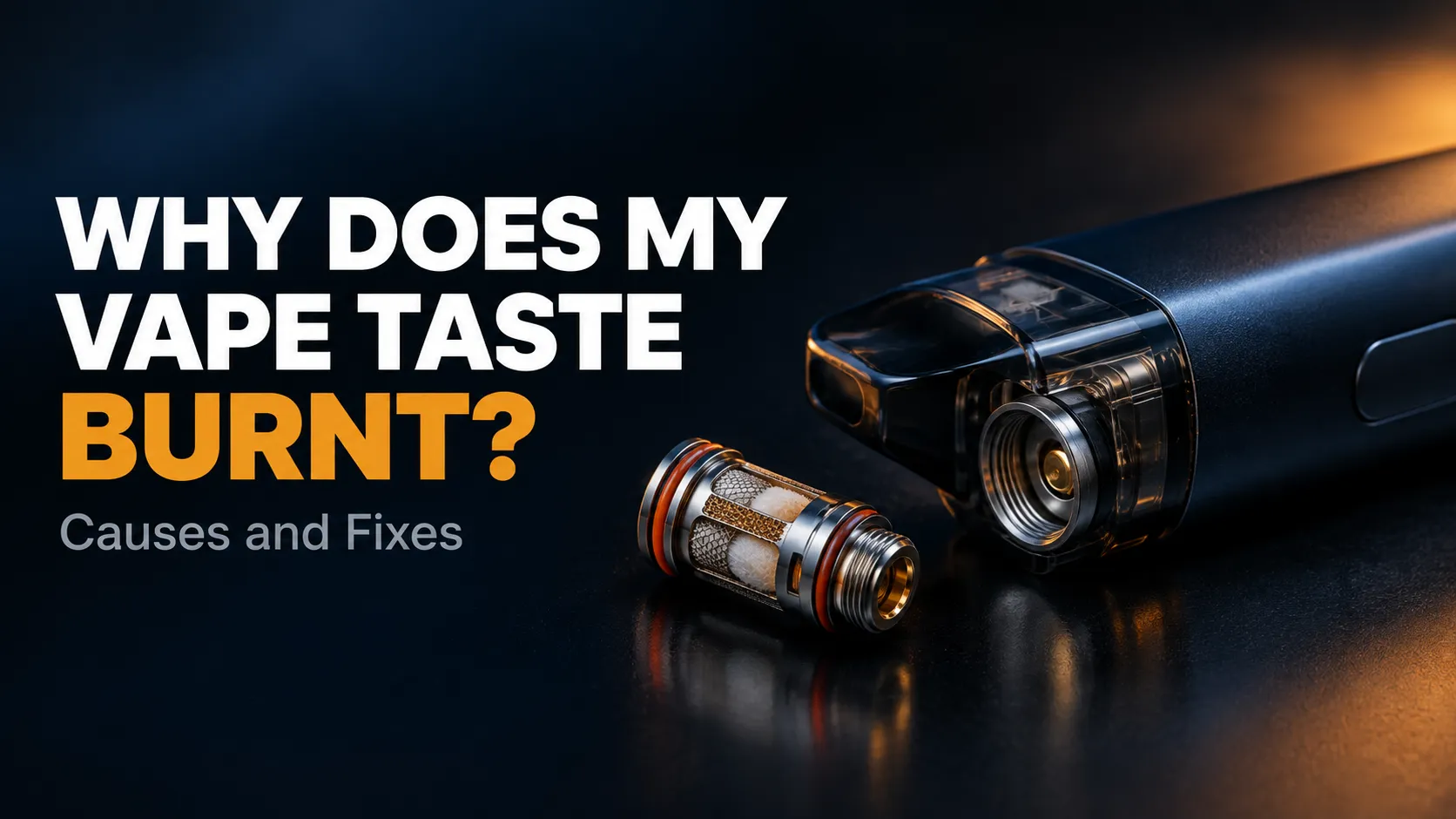
A coil assembly is housed within your pod/tank. It is composed of a material that resists the passage of electric current (typically the wrapped metal wire, or a Kanthal, Nichrome or Stainless Steel mesh perforated strip) tightly wrapped by a wicking material, which is invariably Japanese cotton, organic.
Normal Operation: WWhen you complete the circuit, (inhalation or hit the fire button), the current which passes through the metal coil warms the metal conductor. The e-liquid that collects inside each porous fiber of the cotton wick boils immediately, turning into vapor which carries the flavor.
The Dry Hit Failure State: When power is applied to the cotton wick, it is not thoroughly soaked with the e-liquid, so the fire from the glowing metal coil can't be spread out on it. The strong heat has the effect of burning the organic cotton fibres rather than causing them to vaporize. The horrible smoke you breathe is the smell of the burning cotton.
2. Immediate Troubleshooting: 4 Steps to Save Your Hit
If your vape tastes burnt right now, step through these immediate diagnostic measures before throwing away your current coil or pod.
Step 1: Execute a "Primer Puff" Timeout
If you have been chain-vaping (taking multiple puffs in rapid succession), your wick has likely run dry simply because it cannot keep up with your pace.
- Action: Cease vaping immediately and let the device rest completely for 5 to 10 minutes to allow capillary action to draw liquid back into the center of the wick.
- The Trick: Take 3 to 4 "primer puffs." If using a button-activated device, pull from the mouthpiece without pressing the button. If using a draw-activated pod system, remove the pod from the battery section and take a few firm draws directly on the pod. This creates a physical vacuum within the chimney, forcing static liquid into the dry cotton ports.
Step 2: Check the Cotton Alignment and Fluid Levels
Visually inspect your pod or tank window. Look closely at the metal casing of your coil; you will see small circular or rectangular cutouts where the white cotton wick is exposed to the tank.
- The Threat Line: If your e-liquid level sits below the top of these wicking holes, the upper portion of the cotton is exposed to air. When you tilt the device to vape, the cotton starves.
- Action: Top off your tank immediately. As a rule of thumb, never let your e-liquid drop below 25% capacity.
Step 3: Audit Your Wattage Settings
If you are running a high-power mod, if adjusters are there you may be just running it to be beyond the limits of what your coil can physically handle.
Action: Examine carefully the replaceable coil's metal casing. The best performance parameters are printed on the metal for instance 0.4ohms | 40W - 60W.
The Risk: If the metal is rated as 60W and you use a cap of 65W on that coil, the metal will start heating quicker than the liquid can go back into the coil from the reservoir. Use the lowest setting in the recommended range, or 5W lower than the range below and see if the flavor improves.
Step 4: Inspect for "Coil Gunk" vs. a Charred Wick
Do you turn down your wattage, get your tank filled and let it prime, which nothing seems to have changed the sharp acrid taste of that water for you, your coil has hit the wall!
The Hard Truth: Physical Charring of organic cotton fiber in the inside of a coil is permanent and will cause the wick's structural integrity to be compromised. There are no cure-all hacks, settings to adjust, or any methods of cleaning cotton that can help take the burn out of cotton. Selected new flavor will only come through with each puff as the burned taste lingers on. The coils need to be replaced or the entire pod assembly must be changed.
3. How to Prevent Burnt Coils (Advanced Maintenance)
Coils are a consumable product and are generally good for between 7 and 21 days of use, depending on how often you use them. When the coils burn out within 48 hours, you are probably making one of the following mistakes while operating the product.
The Scientific Guide to Priming a New Coil
Installing a dry, factory-new coil and firing it up immediately will instantly ruin it. You must systematically saturate the inner core before exposing it to electrical current.
1. Internal Saturation: Step 1.
Before threading the new coil into your tank, take your e-liquid bottle and apply 3 to 5 drops of liquid directly onto the mesh or wire screen down the center of the top chimney. Watch it soak completely into the interior cotton walls.
2. External Saturation: Step 2.
Locate the outer wicking holes on the sides of the metal coil casing. Place one drop of e-liquid onto each exposed cotton window to kickstart absorption from the outside in.
3. The Static Rest: Step 3.
Put all components together, fill the tank reservoir to the top with e-liquid and close all the airflow points to stop the tank leaking. Place it completely undisturbed, tilted upright, for at least 10-15 minutes.
4. The Low-Power Break-In: Step 4.
Don't turn up your adjustable mod to your so desired target wattage the instant you buy it! Turn down the wattage by about 15 watts from normal. Puff 3-4 times, slowly and lightly. Take the sweet spot by adding 2-3 watts at a time until you find it after a few puffs. This makes the metal somewhat soft and protects the fresh cotton from thermal shock.
Aligning Viscosity: The VG/PG Balance
E-liquids are formulated using two distinct base fluids: Vegetable Glycerin (VG) and Propylene Glycol (PG). Their physical properties dramatically impact how quickly a wick can absorb them.
| Fluid Type | Physical Characteristics | Vapor Impact | Ideal Hardware |
|---|---|---|---|
| High VG (e.g., 70/30, 80/20) | Thick, syrupy, viscous texture. | Produces dense, large clouds; smooth throat hit. | Large sub-ohm tanks, rebuildable atomizers (RDAs), wide juice ports. |
| High PG / 50-50 (e.g., 50/50, 60/40) | Thin, watery, low viscosity. | Sharp throat hit; carries flavor compounds exceptionally well. | Small pod systems, MTL (Mouth-to-Lung) starter kits, tiny juice ports. |
The Pod Dilemma: If you use a 80% VG e-liquid in a miniature pod system, this liquid is too thick to be taken into the tiny wicking hole of the pods as it trickles in. Dries cotton in 2 hits resulting in burnt coil. However, remember that there is always a 50/50 split or 60/40 split with smaller pod devices.
The Sub-Ohm Dilemma: On the other hand, if you place a thin 50/50 liquid into a high Watt tank with large air holes at the bottom (wicking), will allow the coil to flood or spit hot water into your mouth or tricks out the bottom airflow valves.
The Sweetener Tax: Recognizing "Coil Killers"
If you follow all the rules for hardware exactly but after 2 days your e-liquid selection tankeds along from your cliff, you've got a problem with your e-liquids!
Sometimes the commercial e-liquid profile is over-sweetened, such as those of intense dessert, candy, pastry and tropical fruit, with a lot of the sweetener being made up of artificial sweeteners like sucralose.
Sucralose does not easily vaporize at typical vaping temperatures, unlike PG, VG and nicotine. In its place, it is subject to thermal (pyrolysis) decomposition. These sugars caramelize, cook on the metal heating element and develop a coating that is essentially a blackened thick film of carbon that has been baked onto the element, which the members of the community collectively refer to as "coil gunk."
This layer of crust is a thermal insulator. The metal coil becomes hotter and hotter under the gunk, retaining heat and, over time, burning the surrounding organic cotton. For longer life from the hardware, prefer clear, lightly-sweetened fruit or menthol flavors.
Pre-Flight Checklist for Clean Flavor
- Never let your tank empty out: Refill when the liquid reaches the top of the exposed cotton windows.
- Practice the 15-second rule: Give your wick fifteen seconds to pull in fresh juice between drags.
- Stay within the stamped lines: Match your mod's wattage output to the rating etched on your coil.
- Prime every single change: Never fire a dry coil. Patience during setup saves money and prevents a ruined palate.
Why Trust Ninja Vapes UK?
Lowest Price Guaranteed
Your savings, our promise.
5% Cashback on Orders
Earn rewards with every purchase.
Trusted by customers.
Free delivery over £40
Shop more, save more







0 Replies